Startup CPA services
CPA Services for Startups
Accounting setup, entity and tax structure, bookkeeping, payroll, founder compensation, contractor payments, R&D credits, and investor-ready monthly reporting — under one CPA engagement.
What you get
One CPA team across four pillars
Accounting setup
Chart of accounts, cloud stack, and opening balances built for SaaS, marketplace, or hardware — not a generic small-business template.
Bookkeeping & monthly close
Accrual books, bank/credit-card/Stripe reconciliations, and monthly financials closed within 10 business days.
Payroll & contractors
Founder W-2 payroll, employee payroll across states, and 1099 contractor payments handled in one workflow.
Tax planning & R&D credit
Entity selection, federal + state + Delaware franchise tax, §174 capitalization, and the R&D payroll-tax offset up to $500K/year.
Startup accounting setup
Set the books up right the first time
The chart of accounts, cloud stack, and opening balances you choose in month one drive every report and tax return that follows. We build them for venture-backed and high-growth companies, not for a corner store.
- Delaware C-Corp or LLC entity formation review and post-incorporation cleanup
- QuickBooks Online or Xero setup with a startup chart of accounts
- Bank, credit card, Stripe, Shopify, and Bill.com / Ramp connections
- Document workflow for receipts, vendor W-9s, and expense policies
- Equity stack imported from Carta or Pulley for option-grant tracking
Entity & tax structure
C-Corp, S-Corp, or LLC — modeled before you file
Entity choice drives investor optionality, founder tax, and QSBS qualification. We model the tradeoffs against your fundraising plan and incorporate (or restructure) accordingly.
- C-Corp vs S-Corp vs LLC modeling based on fundraising plans and founder tax
- Delaware vs home-state incorporation tradeoffs (franchise tax, investor preference, QSBS)
- QSBS (Section 1202) qualification review at incorporation and at each round
- Multi-state nexus and apportionment planning before you hire across states
- Foreign-founder structuring (treaty review, W-8BEN, ITIN coordination)
Bookkeeping for startups
Accrual books, monthly close, ASC 606 SaaS revenue
Startups raise on accrual financials and get audited on accrual financials. We close the books to accrual every month, recognize SaaS revenue under ASC 606, and tie deferred revenue out at year-end.
- Accrual bookkeeping with monthly close by the 10th business day
- Revenue recognition under ASC 606 for SaaS contracts and usage-based billing
- Deferred revenue, prepaids, and accrued expense schedules tied out monthly
- Stripe, Shopify, and merchant-processor reconciliations against the GL
- Year-end tie-out package for tax prep and (if needed) audit readiness
Payroll setup
Payroll across every state you hire in
Modern startup payroll runs on Gusto, Rippling, or Deel — but only after the state accounts, workers' comp policy, and benefit integrations are wired correctly. We set them up and own the configuration.
- Gusto, Rippling, or Deel setup with multi-state registrations
- State unemployment, withholding, and local tax accounts opened in each work state
- Workers' comp policy and pay-as-you-go integration
- Employee onboarding (I-9, W-4, state forms) and PTO accrual policies
- 401(k), HSA, and commuter benefit integrations with payroll
Founder compensation
Wages, equity, 83(b), QSBS — handled
Founder pay is half W-2 salary and half equity strategy. We coordinate reasonable-compensation analysis, the 30-day 83(b) clock, ISO/NSO planning, and the QSBS five-year hold for your eventual exit.
- Reasonable-compensation analysis for founder W-2 wages (C-Corp and S-Corp)
- 83(b) election filed within the 30-day IRS window after restricted stock grants
- ISO vs NSO planning and AMT exposure modeling for option exercises
- QSBS five-year holding tracking and exit planning
- Founder expense reimbursement and accountable-plan documentation
Contractor payments
1099 contractors, international payouts, classification
Most startups pay contractors before they hire employees. We handle W-9 collection, worker-classification review, international treaty withholding, and year-end 1099 e-filing — all from inside the same accounting stack.
- W-9 collection and contractor onboarding via Bill.com, Gusto, or Deel
- Worker classification review (W-2 vs 1099) under federal and state rules (incl. AB 5)
- International contractor payments and treaty withholding (Form W-8BEN, 1042-S)
- Year-end 1099-NEC and 1099-MISC e-filing with state copies where required
- Contractor expense and reimbursement workflows kept off payroll
R&D tax credit
Up to $500K/year in payroll-tax offset
Pre-revenue startups can offset employer payroll tax with the federal R&D credit. We run the QRE study, file Form 6765 with the income-tax return, and claim the offset on Form 8974 every quarter.
- Qualified-research-expense (QRE) study covering wages, contractor costs, and cloud compute
- Federal R&D credit on Form 6765 with §41 documentation
- Pre-revenue payroll-tax offset on Form 8974 — up to $500,000/year
- State R&D credits where available (CA, NY, TX, AZ, MA, and others)
- §174 R&D capitalization handled on the income-tax return
Monthly financial reporting
The numbers your board actually asks about
Every month: accrual P&L, balance sheet, cash flow, burn, runway, KPIs, and a written commentary — delivered by the 10th business day, in the same format your investors expect.
- Accrual P&L, balance sheet, and cash flow delivered every month
- Burn, runway, and cash-zero date calculated against the operating plan
- MRR / ARR, net retention, gross margin, and CAC payback for SaaS
- Variance commentary versus budget and last month's forecast
- Board-ready KPI pack and short written management commentary
Investor-ready financials
Survive diligence on the first pass
When the term sheet lands, the data room opens within a week. We keep your trailing 24 months of financials, cap table, revenue schedules, and 409A coordination ready year-round so a raise doesn't trigger a cleanup project.
- Cap table tied out to Carta or Pulley and reconciled to equity on the balance sheet
- Revenue schedules and customer-level MRR for diligence
- Clean 409A coordination and stock-comp expense booked monthly
- Data-room financials: monthly P&L, BS, CF for trailing 24 months
- Audit-readiness checklist for Series B and beyond
FAQ
Startup tax planning FAQs
What are startup CPA services?+
A bundled engagement covering accounting setup, accrual bookkeeping, payroll, founder compensation planning, contractor payments, federal and state tax filings, R&D credits, and monthly investor-ready reporting — all owned by one CPA team instead of stitched together across a bookkeeper, payroll vendor, and tax preparer.
When should a startup hire a CPA?+
Before incorporating, or within 30 days of issuing founder restricted stock so the 83(b) election is filed on time. Waiting until tax season usually means catch-up bookkeeping fees, a missed R&D payroll-tax credit (up to $500K/year), and a rushed Delaware franchise return.
Should I incorporate as a C-Corp, S-Corp, or LLC?+
If you plan to raise priced VC rounds, default to a Delaware C-Corp — investors and QSBS treatment require it. Bootstrapped, profitable service companies are usually cheaper to run as an LLC, often with an S-election. A startup CPA models both and confirms QSBS eligibility before you file.
How is founder compensation typically structured?+
C-Corp founders are W-2 employees once the company can afford payroll; pre-revenue founders often defer. S-Corp owners must take 'reasonable compensation' as W-2 wages before distributions. Restricted stock should be on a vesting schedule with an 83(b) election filed within 30 days of grant.
Can a startup CPA file the R&D tax credit?+
Yes. A strong startup CPA runs the QRE study, files Form 6765 with the federal return, and claims the pre-revenue payroll-tax offset on Form 8974 — worth up to $500,000/year against employer Social Security and Medicare. They also handle §174 R&D capitalization on the income-tax return.
How much do startup CPA services cost?+
Pre-seed startups typically pay $400–$1,500/month for bookkeeping, payroll, and year-end tax. Seed companies run $1,500–$4,000/month bundled with R&D credit and controller work. Series A+ usually pay $4,000–$15,000/month including fractional CFO, audit prep, and multi-state payroll.
What monthly financial reports should I expect?+
An accrual P&L, balance sheet, and cash flow; burn and runway; cash position; MRR/ARR and net retention for SaaS; variance commentary against budget; and a short written narrative — all delivered within 10 business days of month-end.
What makes financials 'investor-ready'?+
Accrual-basis books following GAAP conventions, ASC 606 revenue recognition, equity tied to the cap table, stock-comp expense booked monthly, customer-level MRR available for diligence, and 24 months of clean trailing financials in the data room.
Vetting checklist
Questions to ask a startup CPA
- 1How many venture-backed or high-growth startups do you currently work with?
- 2Do you handle R&D credit, §174 capitalization, and Delaware franchise tax in-house?
- 3What's your monthly close timeline, and what does the deliverable pack include?
- 4Can you support a future audit, 409A valuation, and equity comp accounting?
- 5How is pricing structured as we grow from pre-seed to Series A?
Featured Professionals
Featured startup CPAs and firms
Verified professionals will appear here as profiles are claimed and reviewed.
Keep exploring
Related services
Fractional CFO services
Part-time CFO leadership for forecasting, fundraising, and board reporting.
Tax planning services
Year-round entity, equity, and R&D tax planning for founders.
Outsourced bookkeeping
Monthly accrual books, AP, and reconciliations done for you.
Small business payroll
Multi-state payroll and contractor 1099s handled cleanly.
Small business CPAs
Vetted CPAs for entity setup, returns, and ongoing advisory.
QuickBooks ProAdvisors
Certified ProAdvisors for setup, cleanup, and training.
By city
Find this service by city
Houston, TX
Houston CPAs serve energy, healthcare, and the city's vast small-business community.
Dallas, TX
Dallas accounting firms anchor finance, real estate, and corporate headquarters across DFW.
Los Angeles, CA
LA's accountants specialize in entertainment, real estate, and creative-industry tax planning.
San Francisco, CA
San Francisco CPAs serve startups, venture-backed companies, and complex equity-comp clients.
New York City, NY
NYC's accountants cover Wall Street, media, real estate, hospitality, and the small businesses of all five boroughs.
Miami, FL
Miami's CPAs specialize in international tax, real estate, hospitality, and Latin American business.
Chicago, IL
Chicago accountants serve professional services, manufacturing, logistics, and the Midwest's largest corporate base.
Atlanta, GA
Atlanta's CPAs support film, fintech, logistics, and one of the country's most dynamic small-business scenes.
Boston, MA
Boston-area accountants serve life sciences, higher education, financial services, and innovation-economy startups.
Seattle, WA
Seattle CPAs serve tech, aerospace, and the Pacific Northwest's deep entrepreneurial bench.
Washington DC, DC
Washington DC accountants serve federal contractors, nonprofits, associations, and the law firms that anchor the capital's economy.
Baltimore, MD
Baltimore CPAs serve healthcare systems, port and logistics operators, biotech, and the city's deep nonprofit and higher-ed community.
Startup cluster
Explore related startup guides
CPA for Startups
Hub: find startup CPAs and accounting firms.
Read guideStartup Accounting Services
Monthly close, reporting, and advisory for startups.
Read guideStartup Bookkeeping Services
Accrual books, ASC 606, and Stripe / Shopify clean-up.
Read guideStartup Payroll Services
Gusto, Rippling, Deel, equity comp, multi-state.
Read guideStartup Tax Planning
Delaware franchise, §174, R&D credit, QSBS.
Read guideStartup Accounting Checklist
Stage-by-stage finance setup, pre-seed through Series A.
Read guideCPA for SaaS Startups
ASC 606, MRR/ARR, NRR, Rule of 40.
Read guideCPA for Tech Startups
Marketplace, hardware, AI, fintech tax and books.
Read guideCPA for Funded Startups
Audit prep, 409A, board reporting, fractional CFO.
Read guide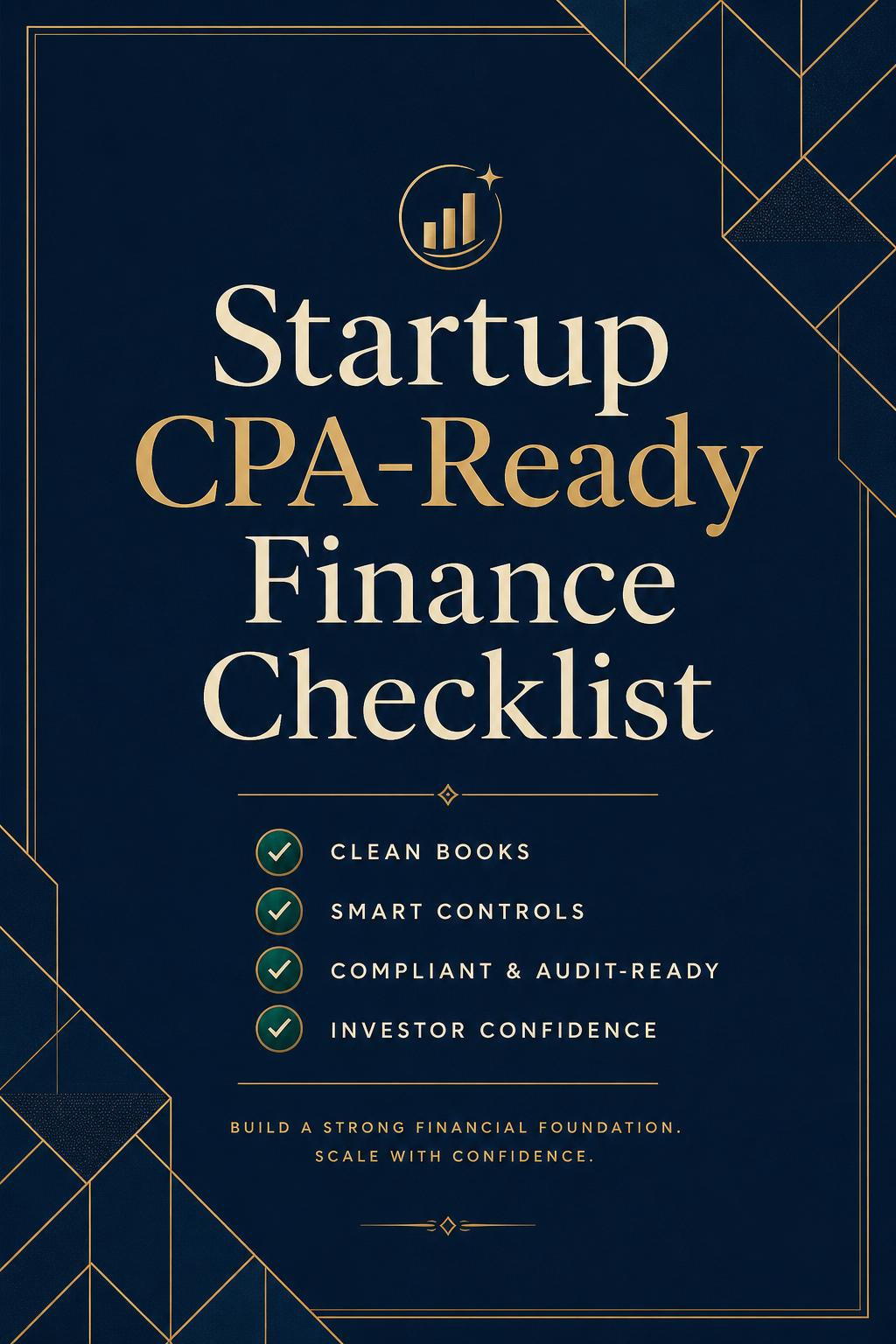
Free download
Startup CPA-Ready Finance Checklist
A founder's checklist for bookkeeping, payroll, tax planning, financial statements, and investor-ready accounting — what your CPA wishes you had before your next close, board meeting, or fundraise.
- Bookkeeping foundations & monthly close
- Payroll, equity comp & 1099 workflow
- Tax planning: §174, R&D credit, QSBS
- Investor-ready statements & KPI pack
Find a Startup CPA
Browse vetted CPAs and accounting firms that already serve venture-backed and high-growth startups.
Find a Startup CPAStartup Accounting Checklist
The stage-by-stage finance setup founders use from incorporation through Series A — bookkeeping, payroll, tax, and reporting.
Download the ChecklistRelated services
More from our accounting services
Accounting services
Full menu of accounting, bookkeeping, payroll, and tax services.
Visit pageBookkeeping and payroll services
Outsourced payroll and bookkeeping bundled under one provider.
Visit pageVirtual bookkeeping services in Miami
Remote bookkeeping for Miami startups and small businesses.
Visit pageBookkeeping services in Charleston
Local Charleston bookkeepers for SC startups and small businesses.
Visit pageNew Hampshire bookkeeper services
NH bookkeeping with BPT and BET tracking.
Visit pageAdvisor-grade guides
Downloadable ebooks & templates
CPA-ready playbooks and templates you can use today — instant downloads, no signup required.
The Small Business Tax & Profit Playbook
A CPA-ready guide to deductions, quarterly taxes, S-Corp strategy, owner pay, cash flow, and year-round tax planning.

Business Tax Deduction Checklist
A CPA-curated checklist of 80+ business deductions most owners miss — organized by category so you can sweep it before filing.
The Definitive Bookkeeping Cleanup & Recovery Guide
The CPA's step-by-step playbook for diagnosing messy books, reconstructing missing history, and restoring a clean, audit-ready ledger.

The Freelancer Tax Guide
The practical tax playbook for freelancers, contractors, and solo creatives — deductions, quarterly estimates, and self-employment strategies.

The Year-End Tax Planning Guide
The CPA's December playbook — practical strategies to reduce your tax bill before the year closes.
The Premium Bookkeeping Template Pack
Automated dashboards, multi-account reconciliations, and CPA-ready reporting workbooks for serious owners and bookkeepers.

Tax & Bookkeeping Resource Library
Our complete advisor-grade collection — every premium asset an owner needs to run clean books, lower taxes, and recover messy ledgers, in one bundle.