Startup CPA
Find a CPA for Startups
Compare startup CPAs and accounting firms for startups — vetted on R&D tax credit, equity compensation, ASC 606 revenue recognition, Delaware C-Corp filings, payroll, and investor-ready financial reporting.
Why specialization matters
Why startups need specialized CPAs
Venture-backed and high-growth companies have tax, accounting, and reporting requirements that generalist CPAs simply don't see often enough to do well.
Equity & cap table
ISO/NSO grants, 83(b) elections, 409A coordination, and clean equity expense on the books.
Deferred revenue & ASC 606
SaaS, marketplace, and milestone billing recognized correctly — the way investors and auditors expect.
R&D capitalization (§174)
Five-year amortization of domestic R&D and the federal R&D credit handled together, not in isolation.
Fundraising due diligence
Books, contracts, and tax filings packaged so a Series A diligence list takes days, not months.
Comparison
Startup CPA vs general CPA
Startup CPA
Built for venture-backed companies.
- Speaks SaaS, marketplace, hardware, and biotech metrics fluently
- Builds books on accrual with ASC 606 from day one
- Files R&D credit + handles §174 capitalization
- Coordinates with VCs, auditors, and 409A providers
- Knows Delaware C-Corp franchise tax and multi-state nexus
- Equity compensation expense booked monthly
General CPA
Built for owner-operator small business.
- Optimizes for owner-operator small businesses
- Cash-basis bookkeeping until forced otherwise
- Rarely files R&D credits or §174 amortization
- No experience prepping a data room
- Treats Delaware as out-of-state paperwork, not core
- Equity grants surface only at tax time
Books
Startup bookkeeping setup
A startup accounting firm sets your books up on accrual basis from day one — even pre-revenue. That means a chart of accounts that separates COGS from operating expense, deferred revenue tracked per contract, and equity expense booked monthly so your P&L matches what a 409A or lead investor expects to see.
For SaaS, that means MRR/ARR rollforwards. For marketplaces, gross merchandise volume vs. net revenue. For hardware, work-in-process inventory and capitalized prototype costs. A general bookkeeper rarely sets any of this up correctly.
Books close monthly — not once a year — typically within 10 business days of month-end, so runway, burn, and gross margin are never more than a few weeks stale going into a board meeting or investor update.
Payroll
Payroll and founder compensation
Once you incorporate and raise outside capital, founders generally need to be on payroll — not 1099 — to satisfy reasonable-compensation rules (especially for S-corps) and to qualify the company for the R&D payroll-tax credit. Your startup CPA will model founder salary against runway, equity dilution, and tax efficiency.
Expect coordinated guidance on 83(b) elections within 30 days of grant, ISO vs NSO exercises, AMT exposure, secondary-sale tax treatment, and state-level apportionment when teams go remote.
Contractor and advisor payments are tracked separately from payroll from day one — W-9s collected at onboarding, payments coded to the right 1099 category, and Form 1099-NEC filed by January 31 for every contractor and advisor paid $600 or more, so year-end never turns into a scramble.
Tax credits
R&D tax credit support
Qualifying startups can offset up to $500,000 per year in payroll taxes using the federal R&D tax credit — even pre-revenue. Engineering salaries, contractor R&D spend, and cloud compute used for development typically qualify.
A startup CPA documents qualifying activities under the four-part test, files Form 6765 with your federal return, claims the payroll-tax offset on Form 8974, and handles §174 capitalization for the same expenses on the income tax return. Treating these in isolation is how money gets left on the table.
Fundraising
Investor-ready financials
What a lead investor expects to find in your data room — and what your startup accounting firm should produce by default.
GAAP-leaning P&L
Monthly accrual P&L, balance sheet, and cash-flow tied to the bank.
MRR / ARR & cohorts
Recurring revenue rollforward, net retention, and cohort retention.
Burn & runway model
Live burn, runway, and scenario model investors can edit.
Cap table reconciliation
Cap table tied to issued securities, 409A, and equity expense.
Audit readiness
Documentation, contracts, and policies ready for Series B-stage audit.
State & sales tax posture
Nexus map and sales-tax registration plan for every state you sell into.
Entities
Delaware C-Corp and LLC tax considerations
Delaware C-Corp
- Delaware franchise tax due March 1 — file the assumed-par method to avoid the default authorized-shares bill.
- Federal Form 1120 due April 15 (or six-month extension on Form 7004).
- Foreign qualification + state income tax in every state you operate in.
- QSBS (Section 1202) planning from incorporation forward.
LLC
- Single-member LLC files on Schedule C; multi-member files Form 1065 + K-1s.
- S-corp election (Form 2553) when profit clears reasonable comp + ~$40K.
- No QSBS — usually convert to C-Corp before raising priced equity.
- State-level LLC annual reports + franchise/privilege taxes by state.
Vetting
Startup accounting firm checklist
Use this checklist when evaluating accounting firms for startups. Strong firms hit every item; pass on firms that miss more than two.
- Specializes in venture-backed or high-growth startups (ask for a client list)
- Files R&D tax credit studies and §174 amortization in-house
- Works in QuickBooks Online or Xero, plus Gusto / Rippling / Deel for payroll
- Closes monthly books within 10 business days
- Has guided clients through priced rounds, SAFEs, and audits
- Provides clear flat-fee pricing with re-scope cadence
- Offers fractional CFO or controller upgrade path
- Carries professional liability insurance and SOC 2 aligned controls
- Provides 2–3 references in your stage and sector
Due diligence
Questions to ask a startup CPA
What does a startup CPA do that a general CPA doesn't?+
A startup CPA structures your books on accrual with ASC 606, handles equity compensation expense, files R&D tax credits, manages §174 capitalization, navigates Delaware C-Corp franchise tax, and prepares investor-ready financials. General CPAs typically optimize for cash-basis owner-operator businesses.
When should a startup hire a CPA or accounting firm?+
Most startups should engage a CPA or accounting firm before incorporating — or immediately after closing a pre-seed or seed round. Waiting until tax season usually means paying for catch-up bookkeeping and missing R&D credits worth $250K+ per year in payroll-tax offset.
How much do accounting firms for startups charge?+
Pre-revenue startups typically pay $400–$1,500/month for bookkeeping + tax. Seed-stage startups run $1,500–$4,000/month bundled with controller work. Series A+ companies usually pay $4,000–$15,000/month including fractional CFO services, audit prep, and R&D credit studies.
Do startup CPAs handle the R&D tax credit?+
Yes — a strong startup accounting firm files the federal R&D credit and the pre-revenue payroll-tax offset (up to $500K/year against payroll taxes) and handles §174 amortization. Ask for redacted past R&D credit studies before signing.
Can a startup CPA help with fundraising?+
Yes. A startup CPA prepares investor-ready financials, a clean cap table reconciliation, contract-by-contract revenue recognition, runway models, and the diligence data room. Many also coordinate directly with lead investor associates.
Do I need a startup CPA if I'm a Delaware C-Corp with no revenue?+
Yes. You still owe Delaware franchise tax (due March 1, often $400–$800 if filed correctly using the assumed-par method), a federal Form 1120, and any state where you have employees or revenue. Missing these triggers penalties and bad-standing flags that complicate fundraising.
Should my startup use a remote/virtual accounting firm or local?+
Most venture-backed startups use a virtual startup accounting firm because the specialization matters more than geography. Local matters more for hardware, biotech, or businesses with physical inventory that need on-site cycle counts.
How do I switch accounting firms without disrupting my books?+
Plan the switch around a clean month-end. Transfer QuickBooks/Xero ownership, payroll provider admin access, prior-year tax returns, and trial balances. A reputable startup CPA will handle the transition for you and reconcile the opening balance before billing for ongoing work.
Directory
Browse startup CPAs and accounting firms
Ready to hire a startup CPA?
Get matched with vetted accounting firms for startups that already serve companies in your stage and sector.
Vetting checklist
Questions to ask a startup CPA
- 1How many venture-backed or high-growth startups do you currently work with?
- 2Do you handle R&D credit, §174 capitalization, and Delaware franchise tax in-house?
- 3What's your monthly close timeline, and what does the deliverable pack include?
- 4Can you support a future audit, 409A valuation, and equity comp accounting?
- 5How is pricing structured as we grow from pre-seed to Series A?
Featured Professionals
Featured startup CPAs and firms
Verified professionals will appear here as profiles are claimed and reviewed.
Keep exploring
Related services
Fractional CFO services
Part-time CFO leadership for forecasting, fundraising, and board reporting.
Tax planning services
Year-round entity, equity, and R&D tax planning for founders.
Outsourced bookkeeping
Monthly accrual books, AP, and reconciliations done for you.
Small business payroll
Multi-state payroll and contractor 1099s handled cleanly.
Small business CPAs
Vetted CPAs for entity setup, returns, and ongoing advisory.
QuickBooks ProAdvisors
Certified ProAdvisors for setup, cleanup, and training.
By city
Find this service by city
Houston, TX
Houston CPAs serve energy, healthcare, and the city's vast small-business community.
Dallas, TX
Dallas accounting firms anchor finance, real estate, and corporate headquarters across DFW.
Los Angeles, CA
LA's accountants specialize in entertainment, real estate, and creative-industry tax planning.
San Francisco, CA
San Francisco CPAs serve startups, venture-backed companies, and complex equity-comp clients.
New York City, NY
NYC's accountants cover Wall Street, media, real estate, hospitality, and the small businesses of all five boroughs.
Miami, FL
Miami's CPAs specialize in international tax, real estate, hospitality, and Latin American business.
Chicago, IL
Chicago accountants serve professional services, manufacturing, logistics, and the Midwest's largest corporate base.
Atlanta, GA
Atlanta's CPAs support film, fintech, logistics, and one of the country's most dynamic small-business scenes.
Boston, MA
Boston-area accountants serve life sciences, higher education, financial services, and innovation-economy startups.
Seattle, WA
Seattle CPAs serve tech, aerospace, and the Pacific Northwest's deep entrepreneurial bench.
Washington DC, DC
Washington DC accountants serve federal contractors, nonprofits, associations, and the law firms that anchor the capital's economy.
Baltimore, MD
Baltimore CPAs serve healthcare systems, port and logistics operators, biotech, and the city's deep nonprofit and higher-ed community.
Startup cluster
Explore related startup guides
Startup Accounting Services
Monthly close, reporting, and advisory for startups.
Read guideStartup Bookkeeping Services
Accrual books, ASC 606, and Stripe / Shopify clean-up.
Read guideStartup Payroll Services
Gusto, Rippling, Deel, equity comp, multi-state.
Read guideStartup Tax Planning
Delaware franchise, §174, R&D credit, QSBS.
Read guideStartup Accounting Checklist
Stage-by-stage finance setup, pre-seed through Series A.
Read guideCPA for SaaS Startups
ASC 606, MRR/ARR, NRR, Rule of 40.
Read guideCPA for Tech Startups
Marketplace, hardware, AI, fintech tax and books.
Read guideCPA for Funded Startups
Audit prep, 409A, board reporting, fractional CFO.
Read guide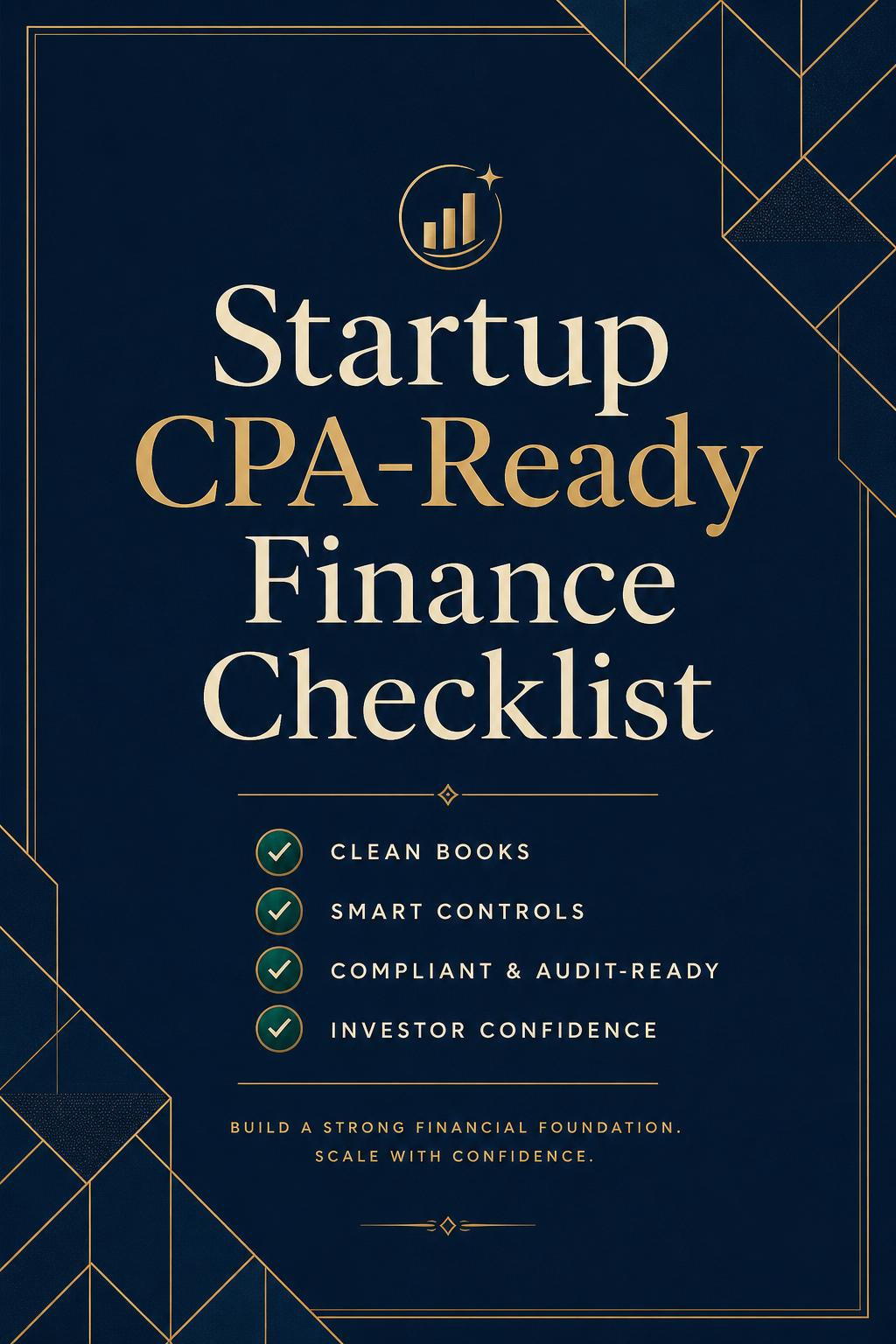
Free download
Startup CPA-Ready Finance Checklist
A founder's checklist for bookkeeping, payroll, tax planning, financial statements, and investor-ready accounting — what your CPA wishes you had before your next close, board meeting, or fundraise.
- Bookkeeping foundations & monthly close
- Payroll, equity comp & 1099 workflow
- Tax planning: §174, R&D credit, QSBS
- Investor-ready statements & KPI pack
Find a Startup CPA
Browse vetted CPAs and accounting firms that already serve venture-backed and high-growth startups.
Find a Startup CPAStartup Accounting Checklist
The stage-by-stage finance setup founders use from incorporation through Series A — bookkeeping, payroll, tax, and reporting.
Download the ChecklistAdvisor-grade guides
Downloadable ebooks & templates
CPA-ready playbooks and templates you can use today — instant downloads, no signup required.
The Small Business Tax & Profit Playbook
A CPA-ready guide to deductions, quarterly taxes, S-Corp strategy, owner pay, cash flow, and year-round tax planning.

Business Tax Deduction Checklist
A CPA-curated checklist of 80+ business deductions most owners miss — organized by category so you can sweep it before filing.
The Definitive Bookkeeping Cleanup & Recovery Guide
The CPA's step-by-step playbook for diagnosing messy books, reconstructing missing history, and restoring a clean, audit-ready ledger.

The Freelancer Tax Guide
The practical tax playbook for freelancers, contractors, and solo creatives — deductions, quarterly estimates, and self-employment strategies.

The Year-End Tax Planning Guide
The CPA's December playbook — practical strategies to reduce your tax bill before the year closes.
The Premium Bookkeeping Template Pack
Automated dashboards, multi-account reconciliations, and CPA-ready reporting workbooks for serious owners and bookkeepers.

Tax & Bookkeeping Resource Library
Our complete advisor-grade collection — every premium asset an owner needs to run clean books, lower taxes, and recover messy ledgers, in one bundle.