An engineering-based cost segregation study reclassifies 20–35% of building basis into shorter-life property eligible for bonus depreciation. The right CPA pairs it with REPS or the STR loophole — and models the depreciation recapture at sale.
Cost Segregation · Studies & Advisory
Find a Cost Segregation CPA
Find a cost segregation CPA. Engineering-based studies, bonus depreciation, Form 3115 catch-up for prior years, and recapture planning at sale.
What they do
Specialized real estate tax & accounting
Generalist firms handle the basics. Real estate CPAs structure the entity, run the depreciation schedule, and protect the deferral when you sell.
Rental property tax
Schedule E preparation, passive loss tracking, and depreciation done correctly on every door.
Cost segregation
Engineering-based studies and Form 3115 catch-up to front-load depreciation deductions.
1031 exchanges
Identification window modeling, boot analysis, and Form 8824 reporting for like-kind exchanges.
Syndications & K-1s
LP K-1 review, multi-state filings, and partner capital account reconciliation.
Cost segregation
Cost segregation studies
An engineering-based cost seg study reclassifies 20–35% of building basis into 5, 7, and 15-year property — eligible for bonus depreciation and a massive first-year deduction.
- Most worthwhile on depreciable basis of $500K+ — below that, fees often eat the benefit
- Bonus depreciation phase-down: 60% in 2024, 40% in 2025, 20% in 2026 under current law
- Catch-up via Form 3115 lets you claim missed depreciation on prior-year placed-in-service properties without amending
- Recapture at sale taxed as ordinary income up to 25% — coordinate with 1031 exit planning
- Pairs powerfully with Real Estate Professional Status to offset W-2 income
- Engineering-based study delivers an IRS-defensible report; rule-of-thumb estimates do not
REPS
Real Estate Professional Status
REPS is the single biggest lever for high-income professionals adding rentals. Qualify, and rental losses become non-passive — offsetting W-2, business, and investment income.
- 750+ hours in real property trades or businesses during the tax year
- More than half of all personal services performed during the year must be in real estate
- Material participation in each rental — or file an aggregation election to treat all rentals as one activity
- Hours log is non-negotiable; the IRS routinely disallows REPS for missing or reconstructed logs
- Spouse's hours don't combine for the 750/half-time tests, but either spouse qualifying applies to the joint return
- REPS plus cost seg plus bonus depreciation is the classic high-W-2 wealth strategy
Airbnb & VRBO
Short-term rental tax planning
STRs sit in a different tax bucket from long-term rentals. The 'STR loophole' — average rental period of 7 days or less plus material participation — lets losses offset W-2 income without REPS.
- Average rental period of 7 days or less flips the property out of passive activity rules
- Material participation (100 hours and more than anyone else, or 500 hours) unlocks loss against W-2
- Substantial services (daily cleaning, meals, concierge) can convert rental to self-employment income subject to SE tax
- Local occupancy and lodging taxes (TOT, hotel tax) tracked separately from income tax
- Cleaning fees, platform commissions, channel manager fees, and supplies separately categorized
- Cost segregation paired with the STR loophole is one of the highest-leverage tax plays available
Rentals
Rental property tax preparation
Schedule E preparation done right — per-property P&Ls, depreciation reconciled, repairs vs. improvements documented, and passive loss limits respected.
- Per-property profit & loss with mortgage interest, property tax, insurance, HOA, and management fees tracked separately
- Depreciation schedule reconciled to current basis; placed-in-service dates verified
- Repairs vs. capital improvements documented for IRS substantiation
- Passive activity loss tracking and $25K active-participation allowance applied where eligible
- 1099-NEC issued to property managers, contractors, and handymen paid $600+
- Schedule E delivered tax-ready by mid-February so personal returns aren't held up
Commercial
Commercial real estate accounting
Office, retail, industrial, and mixed-use properties demand lease-level accounting, CAM reconciliations, and 39-year depreciation handled at scale.
- NNN lease accounting: base rent, CAM, insurance, and real estate tax reimbursements tracked separately
- Annual CAM reconciliations prepared for tenants on a triple-net basis
- 39-year straight-line depreciation (commercial) and 15-year qualified improvement property treatment
- Lease incentive (TI allowance) capitalization and amortization over lease term
- ASC 842 lease accounting on the owner's books where required
- Construction-in-progress tracking with interest capitalization (Section 263A)
Section 1031
1031 exchange reporting
Defer gain on the sale of investment real estate by exchanging into like-kind replacement property. The IRS rules are unforgiving — every day and dollar must be documented.
- 45-day identification window and 180-day closing window run concurrently from the relinquished sale
- Qualified Intermediary required — touching the proceeds disqualifies the exchange
- Identification rules: 3-property rule, 200% rule, or 95% rule — pick one and document it
- Boot (cash or debt relief) is taxable to the extent received — your CPA models this before closing
- Form 8824 attached to the return for the exchange year; basis carries over to the replacement property
- Reverse and improvement exchanges available but require structuring 60–90 days ahead
Planning
Investor tax planning
Real estate tax outcomes are decided in November and at acquisition — not in April. A real estate CPA runs the quarterly modeling that compliance-only firms skip.
- Quarterly estimated-tax projections updated for acquisitions, dispositions, and refinances
- Entity structure reviewed annually as the portfolio grows (sole prop, LLC, multi-member, S-corp for flips)
- Cost seg / bonus depreciation timing coordinated with high-income years
- 1031 exit modeling before listing — boot, debt replacement, basis carryover
- Opportunity Zone deferral and step-up analysis where eligible
- Retirement plan layering: Solo 401(k), SEP-IRA, defined benefit on flip income
What it costs
Real estate CPA pricing
Typical fee ranges in the US. Coastal metros and complex portfolios trend toward the high end; rural and single-property work toward the low.
| Service | Typical range | Notes |
|---|---|---|
| Schedule E per rental property | $300 – $600 | Add-on to a personal return; volume discounts common at 5+ doors |
| LLC return (Form 1065) | $1,200 – $3,500 | Multi-member LLCs and partnerships holding real estate |
| S-corp return (Form 1120-S) | $1,200 – $2,800 | Typical for active flippers and short-term rental operators |
| Cost segregation study | $4,000 – $15,000 | Engineering-based, depending on property size and complexity |
| 1031 exchange coordination | $1,500 – $4,500 | Includes QI coordination, identification modeling, and Form 8824 |
| Monthly bookkeeping (per property) | $75 – $250 | Per-door pricing; AppFolio/Buildium/Stessa integrations included |
| Full-service real estate CPA (annual) | $5,000 – $40,000+ | Bookkeeping plus tax planning plus returns; scales with portfolio size |
Vetting checklist
Questions to ask a real estate CPA
- 1How many real estate investor clients do you serve, and what's your typical portfolio size?
- 2Are you fluent in cost segregation, Real Estate Professional Status, and the short-term rental loophole?
- 3How do you coordinate with my Qualified Intermediary on 1031 exchanges?
- 4Do you prepare partnership returns and syndication K-1s in-house?
- 5Which property management software do you integrate with (AppFolio, Buildium, Stessa, RentManager)?
- 6What's your process for quarterly tax planning vs. compliance-only March work?
- 7How do you handle multi-state filings when I own rentals in different states?
- 8What does your annual fee structure look like for a portfolio my size?
Featured Professionals
Find a Real Estate CPA
Verified professionals will appear here as profiles are claimed and reviewed.
Keep exploring
Related real estate services
Real Estate CPA Directory
National directory of real estate investor CPAs and tax advisors.
CPA for Real Estate Investors
Investor-focused CPAs for syndicators, BRRRR operators, and high-W-2 landlords.
Tax Planning for Real Estate Investors
Quarterly planning across cost seg, REPS, 1031, and entity structure.
Rental Property Accounting Services
Per-door accounting in AppFolio, Buildium, Stessa, and QuickBooks.
Bookkeeping for Real Estate Investors
Property-level books reconciled monthly and tax-ready by year-end.
CPA for Landlords
Schedule E, passive losses, 1099-NEC, and per-door tax prep for landlords.
By city
Find this service by city
Houston, TX
Houston CPAs serve energy, healthcare, and the city's vast small-business community.
Dallas, TX
Dallas accounting firms anchor finance, real estate, and corporate headquarters across DFW.
Los Angeles, CA
LA's accountants specialize in entertainment, real estate, and creative-industry tax planning.
San Francisco, CA
San Francisco CPAs serve startups, venture-backed companies, and complex equity-comp clients.
New York City, NY
NYC's accountants cover Wall Street, media, real estate, hospitality, and the small businesses of all five boroughs.
Miami, FL
Miami's CPAs specialize in international tax, real estate, hospitality, and Latin American business.
Chicago, IL
Chicago accountants serve professional services, manufacturing, logistics, and the Midwest's largest corporate base.
Atlanta, GA
Atlanta's CPAs support film, fintech, logistics, and one of the country's most dynamic small-business scenes.
Boston, MA
Boston-area accountants serve life sciences, higher education, financial services, and innovation-economy startups.
Seattle, WA
Seattle CPAs serve tech, aerospace, and the Pacific Northwest's deep entrepreneurial bench.
Washington DC, DC
Washington DC accountants serve federal contractors, nonprofits, associations, and the law firms that anchor the capital's economy.
Baltimore, MD
Baltimore CPAs serve healthcare systems, port and logistics operators, biotech, and the city's deep nonprofit and higher-ed community.
Common questions
Real estate CPA FAQs
Why hire a real estate CPA instead of a generalist?+
Generalist CPAs handle Schedule E mechanically. Real estate CPAs structure entities, run cost segregation, coordinate 1031 exchanges, and qualify clients for REPS — the work that actually moves the tax bill. On a real estate portfolio, the planning gap between a generalist and a specialist easily covers the fee multiple times over.
When does cost segregation make sense?+
Typically on depreciable basis of $500K+. Below that, the study fee (often $4K–$8K) can exceed the present-value benefit. Cost seg is most powerful when paired with bonus depreciation in high-income years, or with Real Estate Professional Status to offset W-2 income.
How do I qualify for Real Estate Professional Status (REPS)?+
You need 750+ hours in real property trades or businesses, AND more than half of all your personal services for the year must be in real estate. You also need material participation in each rental, or you file an aggregation election treating all rentals as one activity. Keep a contemporaneous hours log — the IRS routinely disallows REPS for poor documentation.
What's the short-term rental tax loophole?+
If your STR's average rental period is 7 days or less AND you materially participate, the property is no longer a passive rental. Losses (especially from cost seg and bonus depreciation) can offset W-2 income directly — without needing to qualify for REPS. It's one of the highest-ROI strategies for high-income professionals adding their first investment property.
How do 1031 exchanges actually work?+
You sell an investment property, the proceeds go to a Qualified Intermediary (you cannot touch them), and you identify replacement property within 45 days and close within 180 days. The gain is deferred — not eliminated — into the replacement property's basis. Done right, you can roll gains forever and step them up at death. Done wrong, you owe tax plus penalties.
Should I put each rental property in its own LLC?+
For meaningful liability isolation, yes. Most attorneys recommend one LLC per property, or grouped by risk profile. Weigh that against annual state filing fees and the cost of multiple partnership returns if the LLCs have multiple members.
How much does a real estate CPA cost?+
Schedule E preparation runs $300–$600 per property. Partnership returns run $1,200–$3,500. Full-service real estate CPAs handling bookkeeping, tax planning, and returns typically charge $5,000–$40,000+ annually, depending on portfolio size and complexity. See the pricing table on this page for the full breakdown.
Do you have to be local to my properties?+
No. Most real estate CPAs work remotely with clients across the country. What matters is whether they know the federal real estate tax code cold and can coordinate state filings wherever your properties sit. Local matters only when state-specific rules (like California's 1031 clawback or Texas franchise tax) demand fluency.
How to choose
How to choose a real estate CPA
Use these criteria to compare candidates side by side and avoid the most common hiring mistakes.
Industry concentration
Ask how many clients in your industry they currently serve. Generalists miss niche credits, filings, and software conventions.
Credentials and licensure
Verify active CPA license, Enrolled Agent status, or relevant certifications (QuickBooks ProAdvisor, Xero Partner, AFSP).
Software stack
Confirm they work in your existing platforms — QuickBooks Online, Xero, Gusto, Sage Intacct — rather than forcing a migration.
Engagement scope and SLAs
Get a written engagement letter that lists deliverables, monthly close date, response times, and what is and isn't included.
Pricing transparency
Prefer fixed monthly fees over open-ended hourly billing for recurring work. Ask what triggers a price increase.
References and reviews
Ask for 2–3 current client references in your industry, plus check independent reviews and state-board status.
Ready to find a real estate CPA?
Browse the verified directory or answer a few questions and we'll match you with a CPA who handles investors, landlords, and syndications.
Industry-specific accounting
Need an accountant who knows your industry?
Talk to a specialist who works with businesses like yours — from construction and real estate to healthcare, restaurants, and nonprofits.
Take the next step
Find a real-estate CPA
Free matching
Get 3 free CPA quotes
Tell us what you need. Up to 3 verified CPAs reply within 1 business day. No fees, no pressure.
Request 3 quotesSide-by-side
Compare CPAs
Stack verified pros next to each other on pricing, specialties, and experience before you reach out.
Compare CPAsFree PDF
2026 CPA Pricing Guide
Real fee benchmarks for tax prep, bookkeeping, payroll, and advisory — by service and business type.
Download free guideRelated industry accounting services
Get matched
Request a free consultation
Share a few details — a vetted CPA will reach out within one business day.
Advisor-grade guides
Downloadable ebooks & templates
CPA-ready playbooks and templates you can use today — instant downloads, no signup required.

The Small Business Tax & Profit Playbook
A CPA-ready guide to deductions, quarterly taxes, S-Corp strategy, owner pay, cash flow, and year-round tax planning.
Business Tax Deduction Checklist
A CPA-curated checklist of 80+ business deductions most owners miss — organized by category so you can sweep it before filing.
The Definitive Bookkeeping Cleanup & Recovery Guide
The CPA's step-by-step playbook for diagnosing messy books, reconstructing missing history, and restoring a clean, audit-ready ledger.
The Freelancer Tax Guide
The practical tax playbook for freelancers, contractors, and solo creatives — deductions, quarterly estimates, and self-employment strategies.

The Year-End Tax Planning Guide
The CPA's December playbook — practical strategies to reduce your tax bill before the year closes.
The Premium Bookkeeping Template Pack
Automated dashboards, multi-account reconciliations, and CPA-ready reporting workbooks for serious owners and bookkeepers.
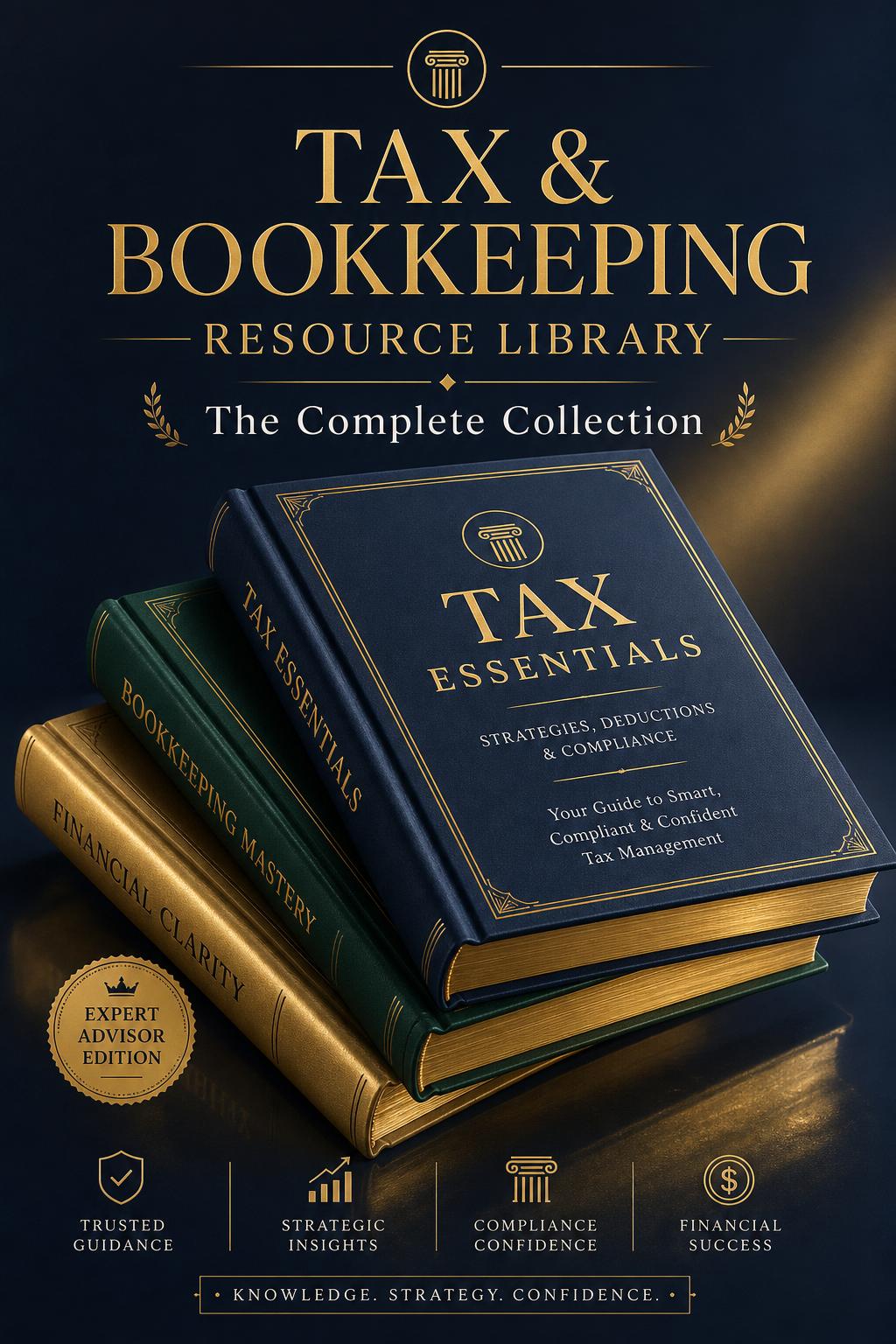
Tax & Bookkeeping Resource Library
Our complete advisor-grade collection — every premium asset an owner needs to run clean books, lower taxes, and recover messy ledgers, in one bundle.